Review · BANGKOK TOURS
Floating Markets and Bridge on River Kwai Tour from Bangkok
The best part of this full-day outing is the sharp change of scene: one minute you’re leaving Bangkok’s traffic behind, and soon you’re gliding through canals lined with boats selling fruit, sweets, vegetables, and souvenirs. I like that Damnoen Saduak Floating Market and the River Kwai sites fit into one organized day, especially when you have limited time in Thailand.
I also like the mix of fun and serious history. The longtail boat ride brings some color and motion, while the JEATH War Museum, Kanchanaburi War Cemetery, and bridge give the day weight. The drawback is simple: there is a lot of driving, and the market can feel crowded, commercial, and less authentic than its old reputation suggests.
In This Review
- Key points to know before booking
- Why this Bangkok day trip works
- Leaving Bangkok through Samut Sakhon
- Coconut sugar and the first commercial stop
- Arriving at Damnoen Saduak Floating Market
- The optional smaller canoe ride
- The long road to Kanchanaburi
- JEATH War Museum and the cost of memory
- Kanchanaburi War Cemetery
- Walking across the River Khwae Bridge
- Guides, group size, and the day’s rhythm
- What to pack and how to prepare
- Who should book this $85.17 tour?
- Final verdict
- FAQ
- How long does the tour last?
- Is hotel pickup included?
- Is the floating market boat ride included?
- Is lunch included?
- What River Kwai sites are visited?
- Is a train ride included?
- How many people can join the tour?
- Can I cancel for a full refund?
Key points to know before booking
- Two major sights in one long day: See Damnoen Saduak and Kanchanaburi without arranging separate transport.
- The canal ride is included: A longtail speedboat takes you toward the floating market, while the smaller market canoe costs extra.
- The optional canoe is worth considering: It costs about 150 baht according to tour information and gives you a closer look at the market boats.
- The River Kwai visit is more than a bridge photo: You also see the JEATH War Museum and the Kanchanaburi War Cemetery.
- Lunch is included, but expectations should stay modest: Food quality can vary, and one account found the meat tough and tofu dry.
- Allow a full day: The advertised duration is about 10 hours, with roughly two and a half hours spent traveling toward Kanchanaburi.
Why this Bangkok day trip works
This tour solves a common Bangkok problem. The floating markets and Kanchanaburi are both worthwhile, but neither sits close to central Bangkok. Reaching both independently means dealing with trains, taxis, local boats, and return transportation. Here, an air-conditioned vehicle handles the long stretches, and a guide organizes the stops.
The price is $85.17 per person. That is not the cheapest way to see either destination, but it covers hotel pickup and drop-off from selected hotels, an air-conditioned vehicle, a local guide, the included boat trip to the market, lunch, museum admission, and the main visits in Kanchanaburi. If you value convenience, the package makes reasonable sense.
You should think of this as a broad introduction, not a slow exploration of either place. The market stop lasts about an hour and a half, while the River Kwai section includes several short visits. You’ll see a lot, but you won’t have much freedom to linger.
The tour details list a maximum of six people, though one account described a group of nine after the initial hotel pickups and transfer. Group size can affect the feel of the day, so it is sensible to confirm the arrangement when booking.
Other Bangkok days people book alongside this one:
- Bangkok: Damnoen Saduak Market and Maeklong Railway Market
★ 4.5 · 26,723 reviews - The Old Siam: Damnoen Saduak and Maeklong Railway Market
★ 4.5 · 10,992 reviews - From Bangkok: Ayutthaya Temples Guided Tour with Lunch
★ 4.7 · 10,535 reviews
Leaving Bangkok through Samut Sakhon
Pickup begins early at selected Bangkok hotels. The minibus may collect people from several locations before taking the group to a main departure point and a larger coach. This transfer system can add time at the beginning, but it is a practical way to gather people from across the city.
Once you leave Bangkok, the scenery changes quickly. The drive passes salt fields in Samut Sakhon province, rice paddies, coconut-growing areas, and open countryside. These views help explain how close Bangkok is to a more rural Thailand, even though the capital itself can feel dense and hectic.
The long drive is part of the bargain. One route description gives about two and a half hours for the journey toward Kanchanaburi after the market, and the total day lasts around 10 hours. Bring water, sun protection, and something small to occupy you during the road sections. Air conditioning is a major comfort here, and several accounts specifically praised the cool, comfortable coach.
Coconut sugar and the first commercial stop
The coconut sugar farm takes about 40 minutes. You see how coconut sugar is made, taste natural candies, and watch an orchid presentation. It is a small stop, but it gives the morning some local food context before the floating market.
This is also the point where expectations matter. The stop functions partly as a shopping visit, and some departures have included extra stops described as orchid or elephant farms. One account found those additions unwanted, especially where animals and staged cultural displays were involved.
The listed itinerary includes the coconut sugar stop, but it does not clearly explain every possible extra visit. If you prefer a tight schedule focused only on the market and River Kwai sites, ask the operator what stops are planned for your departure.
Arriving at Damnoen Saduak Floating Market
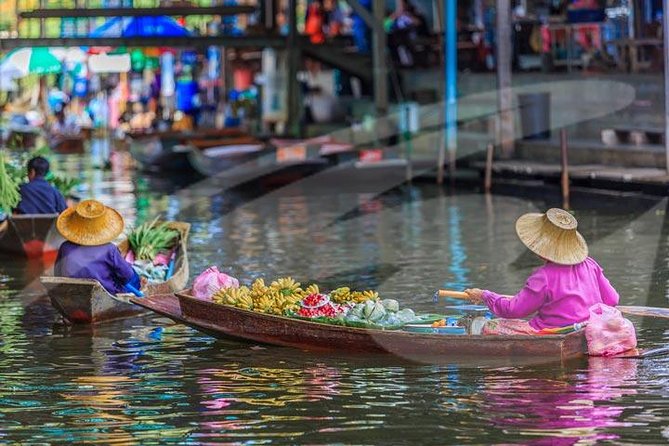
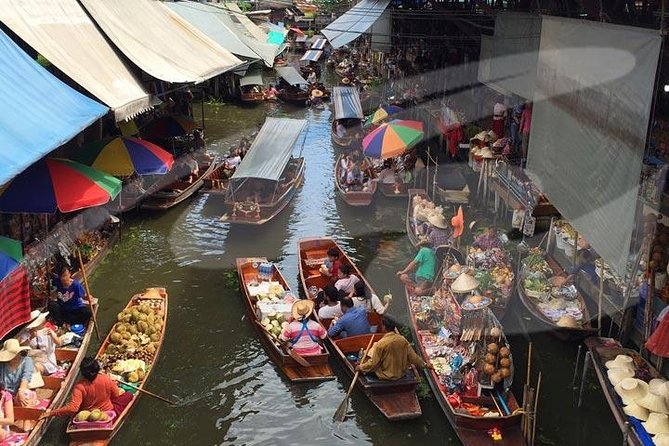
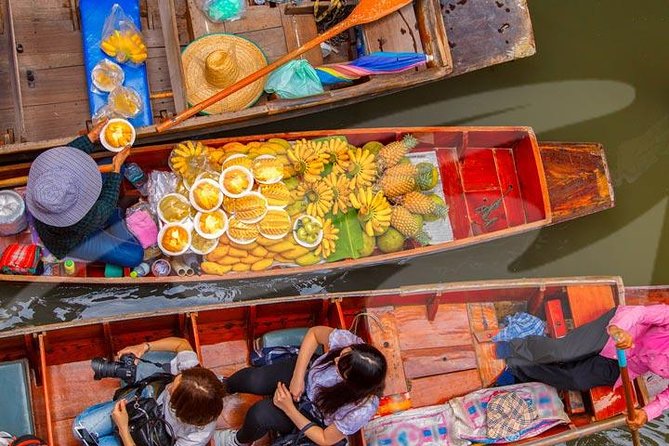
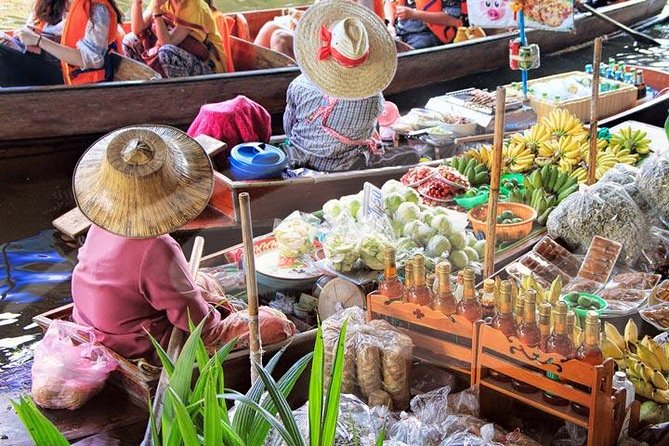
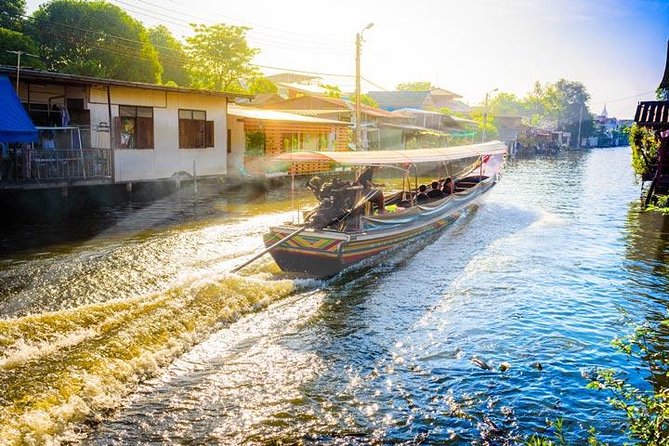
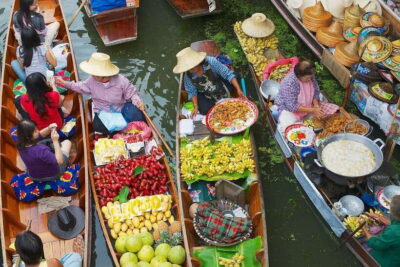
The first big attraction is Damnoen Saduak Floating Market, reached by boat through a network of canals. The included longtail speedboat ride is one of the day’s most enjoyable moments. You pass homes, waterways, and boats carrying colorful fruit, vegetables, sweets, and meat toward the market area.
This is a lively sight, but it is not a quiet rural market. Motorized boats can crowd the canals, causing fumes, noise, and periods when traffic barely moves. You might find the scene exciting and photogenic, or you might find it overly arranged for sightseeing.
The market itself is a blend of canal trade and land-based stalls. Some goods are sold from boats, but plenty of the shopping happens beside the water. The experience is still unusual, though it may not match older images of a fully floating marketplace.
You’ll have time to look around, take pictures, and shop, but the main market visit is only about 90 minutes. That includes getting from the coach to the boat and moving through the market area. If the floating market is your main reason for booking, the schedule may feel short.
Same coastline, a completely different day out:
- Bangkok: Train Market & Floating Market with Boat Ride
★ 4.7 · 9,547 reviews - From Bangkok: Ayutthaya & Ayothaya Floating Market Day Trip
★ 4.7 · 6,084 reviews - Bangkok Canal Tour: 2-Hour Longtail Boat Ride
★ 4.5 · 5,909 reviews - Bangkok: Muay Thai Boxing Tickets at Rajadamnern Stadium
★ 4.9 · 4,740 reviews
The optional smaller canoe ride
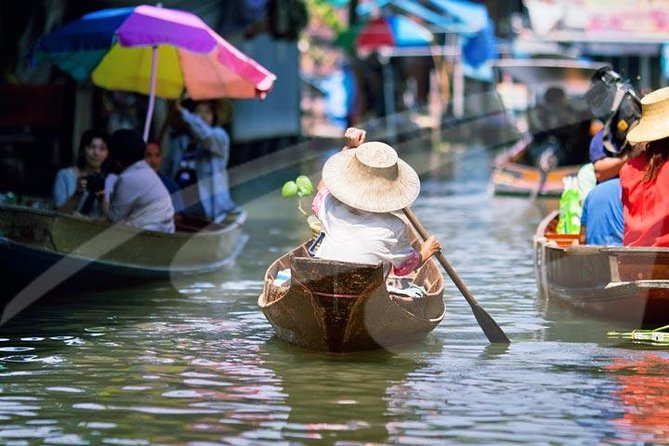
The separate market canoe ride is not included in the tour price. It is payable directly and has been described as costing around 150 baht, or roughly $4 at the time of the cited experience. Your local guide can help arrange it.
I would strongly consider paying for it. The included longtail ride gets you to the market, but the smaller canoe provides a closer, slower look at the boats and canals. It is the better choice if you want to understand how the market works rather than simply arrive, walk around, and take photographs.
Still, check the price before boarding and understand exactly what is included. Some accounts felt that optional charges were not made clear enough in advance, and one account described pressure to buy the extra boat ride. A good guide should explain the cost plainly and let you decide.
Shopping requires care. Prices at Damnoen Saduak can be much higher than at other Bangkok markets, particularly for souvenirs. Compare before buying, and remember that a colorful stall does not mean the price is a bargain.
The long road to Kanchanaburi
After the market, you return to the air-conditioned coach and head west toward Kanchanaburi. This is the day’s longest travel section, and it can make the tour feel like a transportation service with sightseeing breaks.
The payoff is the chance to visit several important locations without arranging separate transfers. The bridge and war sites are not close to Bangkok, so the road time is unavoidable on a day trip. If you dislike long vehicle journeys, consider spending more time in Kanchanaburi instead of trying to combine both areas.
A guide can make this stretch more useful by explaining the countryside and the wartime project before you arrive. Guide quality seems to matter greatly. Guides named in positive accounts include Nikko, Yelli, and Suki, with praise for clear explanations, kindness, and good care of the group. Other accounts found the commentary limited or difficult to understand.
JEATH War Museum and the cost of memory
Lunch is taken at a local restaurant before or around the museum visit, depending on the day’s running order. The meal is included, which saves you the trouble of finding food during a tightly timed schedule. Quality may vary, so treat lunch as practical fuel rather than a highlight of Thai cooking.
The JEATH War Museum contains pictures and paintings about the bridge and the wartime railway project. The name refers to Japan, England, America, Australia, Thailand, and Holland, the countries connected with the wartime story presented at the museum.
The visit is brief, about 30 minutes. That is enough for a quick orientation, but not enough for a careful study of the displays. I recommend reading about the Burma and Thailand railway before the tour so the museum’s short presentation has more meaning.
The bridge was built in 1943 as part of a Japanese wartime plan to connect existing Thai and Burmese railway lines and support the occupation of Burma, now Myanmar. More than 100,000 conscripted laborers and 12,000 prisoners of war died during the wider project. That figure is why the bridge should not be treated as just a scenic photo stop.
Kanchanaburi War Cemetery
The Kanchanaburi War Cemetery is another short visit, usually around 30 minutes. It is the final resting place for many prisoners of war who died during the railway construction.
The cemetery is quieter than the market and bridge. Take a moment to walk among the graves and read the names. The compact stop can feel more affecting than the museum because the scale of the loss becomes personal.
The visit is also a reminder that the River Kwai story is not only about famous film images or an old railway bridge. The project relied on forced labor under brutal conditions, and the cemetery gives the historical account a human face.
Walking across the River Khwae Bridge
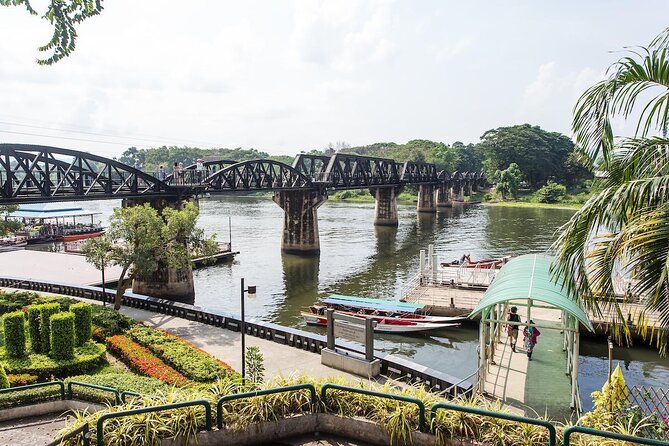
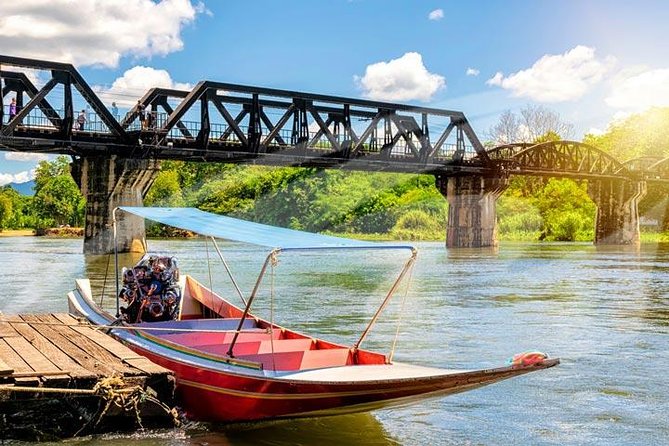
The bridge stop lasts about 30 minutes. You can get close to the steel structure, take photographs, and possibly time your visit with a train crossing. One account specifically enjoyed seeing a train pass over the bridge.
Keep the setting in perspective. The present bridge is a working railway bridge, not an untouched wartime relic. Sections were damaged during the war and later repaired, so the bridge you see today is a modern working structure with wartime associations.
That does not make the visit pointless. The value lies in standing at the place connected with the railway project, then pairing it with the museum and cemetery. The bridge alone might disappoint anyone expecting a preserved monument, but the three sites together provide a more useful visit.
Guides, group size, and the day’s rhythm
A strong guide can turn this tour from a checklist into a meaningful day. The best guiding accounts describe patient explanations of the land, the market, and the wartime sites. Nikko received especially warm praise for explaining key details and taking time with the group. Yelli and Suki were also singled out for helpful, attentive service.
The weak point is uneven commentary. Some departures have had little explanation during the long drives, and some people found the guide hard to understand. That matters because so much of the experience depends on context. The market can look like a row of souvenir stalls, and the bridge can look like an ordinary railway crossing unless someone explains what you are seeing.
The pace is generally steady. You move from hotel pickup to countryside, sugar farm, market, coach journey, lunch, museum, cemetery, bridge, and return trip. There is not much idle time, but there is also little room to change the plan.
What to pack and how to prepare
Bring a refillable bottle or extra drinking water. One account noted that no water or cool cloth was provided, and the heat can make the outdoor portions tiring.
A face mask may be useful around the market canals because motorized boats can create unpleasant fumes. Wear shoes that are easy to walk in and bring sun protection for the open-air stops.
Read a little about the River Kwai railway before leaving Bangkok. Even a basic understanding of the Japanese occupation, prisoner-of-war labor, and the railway’s purpose will make the museum and cemetery far more powerful.
You should also keep your shopping budget separate from the tour price. The market is designed to sell, and the included boat transfer does not include purchases or the optional smaller canoe.
Who should book this $85.17 tour?
I would book this tour if you have one free day in Bangkok and want a simple way to combine two distant destinations. It suits first-time visitors who prefer organized transport, families who do not want to coordinate several connections, and anyone who wants a basic introduction to Kanchanaburi’s wartime sites.
It is also a good choice if you enjoy variety. You get canals, countryside, food, shopping, a museum, a cemetery, and a famous bridge in one day.
I would not choose it if you want a slow, authentic market visit or detailed history. The market can be crowded and commercial, the driving is long, and the optional charges and extra stops may frustrate you. A dedicated Kanchanaburi stay would give you more time at the historical sites, while a separate market visit could allow a slower morning.
At $85.17, the value is strongest when you count the transport, guide, lunch, admissions, and hotel service together. It is weaker if you care mainly about spending several hours at the floating market. Before booking, confirm pickup eligibility, expected group size, optional boat pricing, and whether any extra commercial or animal-related stops are planned.
Final verdict
This is a useful, busy introduction to two of central Thailand’s best-known day-trip sights. The floating market offers memorable canal scenery, while Kanchanaburi adds the serious historical core. The day is well suited to a first visit, but the long road time and commercial feel mean you should book it for convenience, not depth.
If you have only one day and want both destinations, book it. If you can spare extra time in Thailand, visit Kanchanaburi separately and give the River Kwai sites the attention they deserve.
FAQ
How long does the tour last?
The tour lasts approximately 10 hours, including hotel pickup, travel between Bangkok, the floating market, Kanchanaburi, and the return journey.
Is hotel pickup included?
Hotel pickup and drop-off are included from selected hotels. You must provide your hotel details when booking, or the booking may be canceled.
Is the floating market boat ride included?
The longtail speedboat trip to the Damnoen Saduak Floating Market is included. A separate smaller boat ride through the market is optional and payable directly.
Is lunch included?
Yes, lunch at a local restaurant is included in the tour.
What River Kwai sites are visited?
The tour visits the JEATH War Museum, Kanchanaburi War Cemetery, and the River Khwae Bridge.
Is a train ride included?
A train ride is included only if you select the option that includes it.
How many people can join the tour?
The tour information states that the maximum is six participants. One described departure had nine people after hotel pickups and a transfer, so confirm the expected group size before booking.
Can I cancel for a full refund?
You can cancel at least 24 hours before the experience start time for a full refund. Cancellations or changes made less than 24 hours before the start time are not accepted for a refund. If minimum numbers are not met and the operator cancels, you will be offered an alternative or a full refund.
Just added around Bangkok
- Damnoen Saduak Floating Market Small Group Tour★ 4.0 · 107 reviews
- Angkor Wat 2-Day Tour from Bangkok★ 5.0 · 8 reviews
- Arrival Private Airport Transfer : Bangkok Airport to Hotel in Bangkok★ 4.5 · 142 reviews
- Private Best of Bangkok Full Day Highlights City Tour★ 4.5 · 13 reviews
- Ancient Wonders of Ayutthaya with Return Scenic River Cruise★ 4.0 · 31 reviews
- Private Ancient city of Ayutthaya Shore Excursion★ 5.0 · 9 reviews
- Ancient City Ayutthaya Private Guided Day Tour★ 5.0 · 49 reviews
- Ancient City Bangkok and Erawan Museum Tickets★ 4.5 · 8 reviews
Bangkok Tours, compared.
Damnoen Saduak Market and Maeklong Railway Market
Read our review →
The Old Siam: Damnoen Saduak and Maeklong Railway Market
Read our review →
Train Market & Floating Market with Boat Ride
Read our review →
Ayutthaya & Ayothaya Floating Market Day Trip
Read our review →
Bangkok Canal Tour: 2-Hour Longtail Boat Ride
Read our review →
Muay Thai Boxing Tickets at Rajadamnern Stadium
Read our review →