
Review · MARKETS
Chiang Mai Temples and Market Tuk-Tuk Evening Night Tour
Chiang Mai’s temples take on a different mood after sunset. This four-hour tuk-tuk tour moves you between illuminated shrines, then leaves you at the Night Bazaar with a simple meal and dessert. It is a handy way to see several central sights without wrestling with directions in the dark.
I like the cool evening air and the open-sided ride between stops. I also like having a guide explain Buddhist customs, temple symbols, and local history instead of simply collecting photographs. The main caution is that the experience depends heavily on your guide’s English and on weather, and the advertised temple count may not match the actual route every night.
In This Review
- Key points to know before booking
- Why evening is the right time for temple hopping
- Wat Phra Singh, Chiang Mai’s most important first stop
- Wat Phan Tao and the value of a good explanation
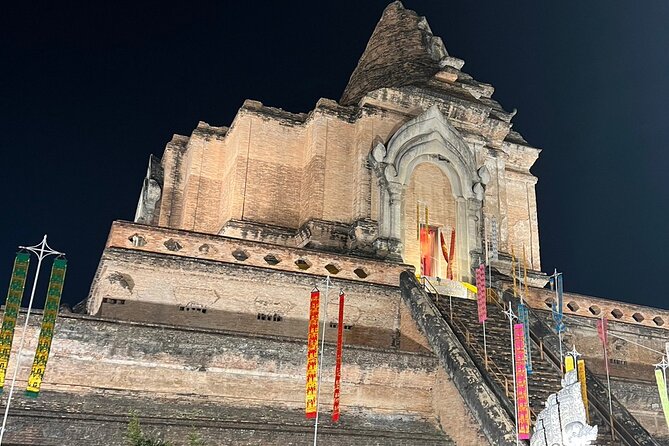
- Wat Chedi Luang, the great stupa in the dark
- Wat Lok Molee adds a quieter change of scene
- The Night Bazaar turns sightseeing into dinner
- What the $34.24 price really buys you
- The guide matters more than the tuk-tuk
- Weather, comfort, and practical limits
- Who should book this Chiang Mai night tour?
- Should you book it?
- FAQ
- How long does the Chiang Mai temple and market tour last?
- Where does the tour start?
- Where does the tour end?
- Which temples are included?
- Are temple entrance fees included?
- Is food included?
- How many people can join the tour?
- What happens if it rains?
- Can I cancel for a full refund?
Key points to know before booking
- Temples glow after dark: Wat Phra Singh, Wat Phan Tao, Wat Chedi Luang, and Wat Lok Molee offer a cooler, quieter alternative to daytime sightseeing.
- Tuk-tuks save time: You ride between central sights rather than walking across Chiang Mai’s old city and nearby streets.
- Food is included: Expect a simple street-food meal, dessert, and bottled water, but drinks and extra snacks cost more.
- Two entrance fees are extra: Wat Phra Singh and Wat Chedi Luang each require THB50 in cash.
- The Night Bazaar is the finale: The tour ends at Chiang Mai Night Bazaar, not at the original meeting point.
- Small groups help: The maximum is 12 people, though some departures may be much smaller or even private by chance.
Why evening is the right time for temple hopping
Chiang Mai can feel hot and tiring during the day, especially when you are walking from one temple to another. Starting at 6:30 pm gives you a break from the strongest heat, while the fading light and nighttime illumination make the buildings more photogenic.
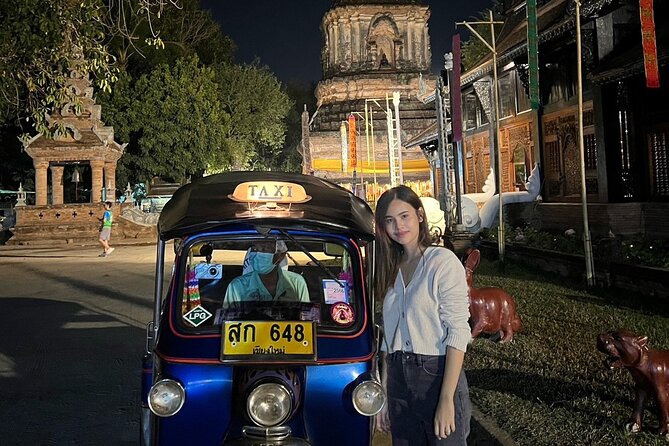
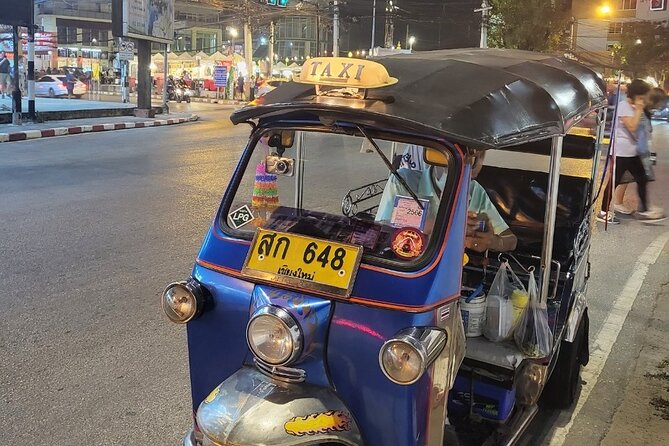
The tuk-tuk is part of the appeal, not just transport. You get the breeze, street sounds, and quick glimpses of the old city as you move along. It also gives your feet a rest between temple visits. I would not choose this tour only for transport, since tuk-tuks are easy to arrange independently, but the combination of transport, explanations, and food makes the package more useful.
The tour begins at Burger King on Rachadamnoen Road near Thapae2. You need to arrive on time: the group waits no more than 10 minutes before moving on. The ending point is Chiang Mai Night Bazaar on Changklan Road, so plan your route back to your hotel before you set out. The finish is at least a substantial walk from some parts of the old city.
A few more Chiang Mai trips to weigh up
- Private Chiang Mai Old City Half Day Tuk Tuk Tour
★ 4.5 · 157 reviews - Full-Day Guided Tuk Tuk Chiang Mai Adventure and Rafting
★ 5.0 · 140 reviews - Chiang Mai: Exploration of Old City by Private Tuk-Tuk
★ 4.3 · 127 reviews
Wat Phra Singh, Chiang Mai’s most important first stop
Wat Phra Singh is one of the best-known temples inside the old city walls. Its name is often translated as Monastery of the Lion Buddha, and it remains an active place of worship rather than a silent museum.
The scheduled visit is about 30 minutes. That is enough for an introduction to the temple’s design, religious role, and major images, but not enough for a slow, detailed inspection of every building. The nighttime setting helps you focus on the lit architecture without the glare and heat of midday.
This is one of the two stops with an entrance charge. The fee is THB50 per person, payable in cash and not included in the tour price. Bring Thai baht so you are not caught short at the gate.
Dress respectfully for all temple visits. The supplied information does not spell out a dress code, but these are functioning Buddhist temples, so covered shoulders and knees are the sensible choice. You may also need to remove your shoes in certain areas.
Wat Phan Tao and the value of a good explanation
Wat Phan Tao is one of Chiang Mai’s older temples, with early structures dating probably to the late 14th century. It sits next to Wat Chedi Luang inside the old city, making it an efficient pairing with the next stop.
Admission is free, and the visit lasts around 30 minutes. The temple is smaller than some of Chiang Mai’s grander sites, so the guide’s explanation matters here. A well-paced guide can point out construction details, sculptures, and religious practices that you could easily miss while walking around on your own.
Guides named in the tour feedback include Jane, Saman, Nancy, Tik, Molly, Maa, Malee, and others. Several departures were praised for clear explanations of Buddhism, temple construction, the age of buildings, and the meaning of sculptures. Tik was singled out for explaining Buddhist practice and the way different religious influences have blended in Thailand.
That praise comes with an important warning. A few departures had guides whose English was difficult to understand, with little opportunity for questions. If learning through conversation is central to your plans, the guide assigned on the evening will make a real difference.
Wat Chedi Luang, the great stupa in the dark
Wat Chedi Luang is known as the Temple of the Great Stupa. Its main construction took place from 1391 to 1475, and the great structure was damaged by an earthquake in 1545. What you see today is an imposing ruin, but the scale remains easy to appreciate, especially when the stone is lit at night.
The planned visit is another 30 minutes. This is a stop where a guide can add real value by explaining what has survived, what was lost, and how the temple fits into Chiang Mai’s older religious center.
Admission costs THB50 per person and is separate from the $34.24 tour price. That means you should budget at least THB100 in total for the two paid temples. Food, water, tuk-tuk transport, and guiding are included, but personal purchases and alcoholic or soft drinks are not.
Some people find three temples enough for one evening, particularly after a full day of sightseeing. The tour description lists four temple stops, but the timing and actual number can vary in practice. Several accounts describe visiting three temples, and one person felt that two would have been sufficient. If you prefer a relaxed pace with long visits, this may feel rushed.
Same coastline, a completely different day out:
- Half-Day Thai Cooking Class at Organic Farm in Chiang Mai
★ 5.0 · 19,087 reviews - Chiang Mai: Elephant Sanctuary, Waterfall & Bamboo Rafting
★ 4.9 · 9,160 reviews - Chiang Mai: Doi Inthanon National Park Eco-Friendly Tour
★ 4.6 · 6,667 reviews - Chiang Mai: Elephant Sanctuary & Waterfall Group Tour
★ 4.9 · 5,780 reviews
Wat Lok Molee adds a quieter change of scene
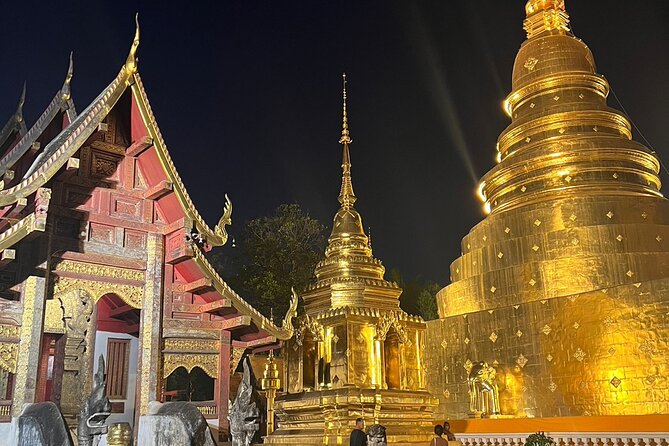
Wat Lok Molee lies just outside the old walled center and is one of Chiang Mai’s older temples. It is known for a large and impressive chedi, according to the supplied description, and admission is free.
This stop gives the route a little variety. You are no longer seeing only temples packed close together in the old city. The guide can also help you compare the architecture and setting with the earlier stops.
Again, the scheduled time is 30 minutes. That sounds generous on paper, but tuk-tuk loading, traffic, temple etiquette, and group movement all use part of the evening. You should think of this as a well-chosen overview, not an expert architectural study.
If the guide spends most of the evening on Buddhism, you may hear less about everyday Chiang Mai, food, neighborhoods, and city development. Some people valued the religious focus, while others wanted more general information about Chiang Mai. I would ask questions as you go if you want a wider picture.
The Night Bazaar turns sightseeing into dinner
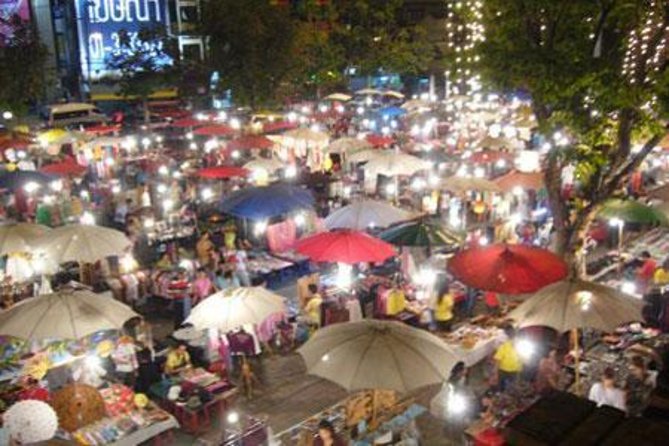
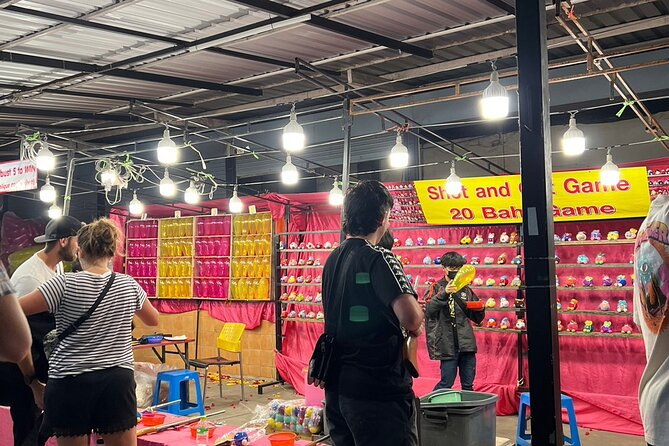
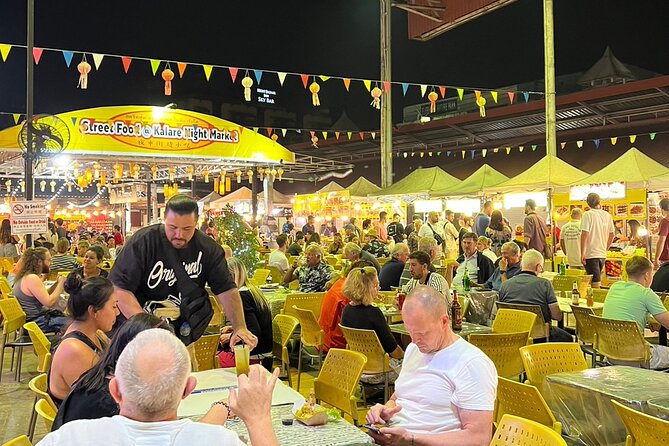
The final stop lasts about 90 minutes at Chiang Mai Night Bazaar, the city’s best-known evening market. Stalls sell clothing, handicrafts, and food, giving you time to browse after the more structured temple visits.
A simple street-food meal and dessert are included, along with a bottle of drinking water. The food stop is a strong part of the value for first-time visitors because choosing dishes at a Thai market can be confusing when you do not know the ingredients or prices.
The exact meal should not be treated as a full food tour. One account describes the guide visiting two food stalls and arranging the included food, without a dessert or beverage. Other accounts describe a delicious dinner, food-court dishes, and local specialties such as khao soi. The safest expectation is a basic included meal, with the freedom to buy more from nearby vendors.
Guides can also make the market easier to handle. Jane was praised for walking through the stalls, explaining local food, and speaking with vendors. That kind of help is useful if you are unsure what to order or how to navigate the market’s busy streets.
You will need to make your own way home from here. The tour does not include hotel pickup or a return transfer. Check the walking distance and transport options before booking, especially if your hotel is in the old city or if you prefer not to navigate unfamiliar streets after dinner.
What the $34.24 price really buys you
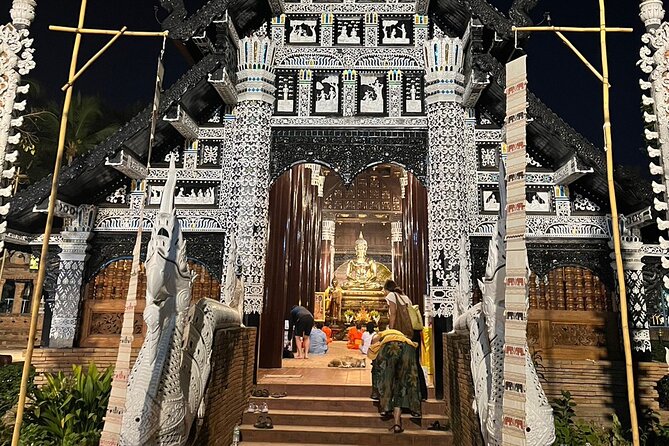
At $34.24 per person, the tour is not the cheapest way to see Chiang Mai’s temples. You can visit some temples independently, hire a tuk-tuk for individual rides, and eat at the Night Bazaar without joining a group.
The price makes more sense if you want several pieces handled at once: a driver, an English-speaking guide, an organized route, bottled water, and a food stop. You also avoid negotiating separate tuk-tuk fares and figuring out which temple to visit next.
Remember to add THB100 for the two listed entrance fees. You may also spend more at the market, since soft drinks, alcohol, extra dishes, desserts beyond the included portion, and souvenirs are personal expenses. Gratuities for the guide and driver are optional.
For a small group, the value improves. Some departures have had only two or three people, allowing plenty of questions and a more personal pace. Other departures may reach the maximum of 12, which can make temple movement and food ordering slower.
The guide matters more than the tuk-tuk
The strongest part of this experience is the human explanation. Guides such as Jane and Saman received especially warm praise for clear, engaging talks about Thai history, Buddhism, building methods, monks, and temple art. Nancy, Molly, Maa, and Tik were also described as friendly and helpful.
That said, the quality is not perfectly consistent. A few people found the English hard to follow and felt there was little engagement. Since the tour is built around learning, this is not a minor issue. The tuk-tuk ride is fun, but it cannot make up for explanations you cannot understand.
The best way to get more from the evening is to ask direct questions. Ask why a statue has a certain form, how the temple is used today, or what makes one structure different from the next. You will get a better sense of the city if you request some local history alongside the Buddhist background.
Weather, comfort, and practical limits
The tour runs in rain or shine. Tropical showers may pass quickly, but heavy rain can interrupt the route while the group takes shelter. Bring a raincoat or poncho during the wet season. The operator does not provide a weather-based refund for cancellations.
Open tuk-tuks are pleasant in dry weather and offer a cool breeze between stops. In heavy rain, they can be uncomfortable. One poor experience involved a tuk-tuk without plastic side covers, an umbrella that did not help much, and a missing step that made getting in and out difficult. That was not the normal experience described by most accounts, but it is a useful reminder that tuk-tuk comfort can vary.
Most people can participate, and the tour is near public transport. The maximum group size is 12. The information provided does not promise wheelchair access or special mobility arrangements, so contact the operator before booking if you have mobility concerns.
Who should book this Chiang Mai night tour?
I would choose this tour if you have only a short time in Chiang Mai, want an evening activity, or feel uneasy arranging tuk-tuks and food stops alone. It works especially well as an introduction on your first night because it gives you a quick sense of the old city, nearby temples, and the Night Bazaar.
It also suits you if heat is a problem. The evening start and open-air rides are much easier than a long temple walk under the afternoon sun.
I would be less keen on it if you have already visited the main old-city temples, prefer slow photography, or want a serious food tour. You may find the four-hour schedule tight, and the actual temple count may be three rather than four. It is also not ideal if a guide’s English clarity is your top concern, since that has varied.
Book at least 24 hours before the start time if your plans are uncertain. Cancellation is free until then, but cancellations or changes inside the 24-hour window are not refunded or accepted.
Should you book it?
Yes, if you want an easy, social introduction to Chiang Mai after dark. The combination of glowing temples, tuk-tuk rides, an included meal, and a Night Bazaar finish gives you a lot in one evening for a moderate price.
Go in with realistic expectations. Pay the extra THB100 for temple admission, bring rain protection, arrive before the 10-minute grace period ends, and remember that you finish at the market rather than at the starting point. If you get a guide like Jane, Saman, Tik, Nancy, or Molly, the evening can be both fun and genuinely informative. If you want complete control over timing, hire your own tuk-tuk and visit fewer temples at your own pace.
FAQ
How long does the Chiang Mai temple and market tour last?
The tour is scheduled for approximately four hours, beginning at 6:30 pm and ending at Chiang Mai Night Bazaar.
Where does the tour start?
It starts at Burger King, Thapae2, 6 Rachadamnoen Road, in Chiang Mai’s old city area.
Where does the tour end?
The tour ends at Chiang Mai Night Bazaar on Changklan Road.
Which temples are included?
The planned route includes Wat Phra Singh, Wat Phan Tao, Wat Chedi Luang Varavihara, and Wat Lok Molee. The actual number visited can vary.
Are temple entrance fees included?
No. Wat Phra Singh costs THB50 per person, and Wat Chedi Luang costs THB50 per person. Both fees must be paid in cash on the day.
Is food included?
Yes. The tour includes a simple street-food meal, dessert, and a bottle of drinking water. Soft drinks, alcoholic beverages, and extra personal purchases are not included.
How many people can join the tour?
The maximum group size is 12 people.
What happens if it rains?
The tour operates in rain or shine. The group may seek shelter during heavy rain and continue when conditions improve. A raincoat or poncho is recommended during the rainy season.
Can I cancel for a full refund?
Yes, if you cancel at least 24 hours before the scheduled start time. Cancellations or changes made less than 24 hours before the start are not refunded or accepted.
More Evening Experiences in Chiang Mai
- Chiang Mai: Doi Suthep and Wat Umong Enchanting Evening Tour
★ 4.6 · 1,811 reviews - Small-Group Chiang Mai Evening Street Food Tour
★ 4.5 · 826 reviews - Chiang Mai: Evening Local Street Food Market Tour
★ 4.8 · 604 reviews - Chiang Mai: Kalare Night Bazaar Boxing Stadium Muay Thai
★ 4.7 · 507 reviews
More Shopping Tours in Chiang Mai
- Chiang Mai: Cooking Class, Market & Thai Herbs Garden Tour
★ 4.9 · 4,824 reviews - Chiang Mai: Authentic Cooking Class with Market & Farm Visit
★ 4.9 · 4,546 reviews - Chiang Mai: Cooking Class with Market and Pickup
★ 4.9 · 1,365 reviews - Chiang Mai: Evening Cooking Class and Local Market Visit
★ 4.9 · 648 reviews
Just added around Chiang Mai
- Chiang Mai Zipline White Water Rafting and Elephant Sanctuary★ 4.0 · 11 reviews
- Chiang Mai Airport Private Transfer – Hotel or Airport★ 4.5 · 51 reviews
- Zipline Adventure at Skyline Jungle Luge Chiang Mai★ 5.0 · 102 reviews
- Trek to a Jungle Waterfall★ 5.0 · 14 reviews
- Long Neck Village, White & Blue Temple, Black House Day Tour From Chiang Mai★ 4.0 · 14 reviews
- 2 Hours Wow hatcha lanna package – Free transportation★ 5.0 · 31 reviews
- Zipline+Sticky waterfall+Long Neck Village Private Tour★ 5.0 · 22 reviews
- Authentic Thai Cooking Class and Farm Visit in Chiang Mai★ 5.0 · 66 reviews
Markets, compared.
Damnoen Saduak Market and Maeklong Railway Market
Read our review →
The Old Siam: Damnoen Saduak and Maeklong Railway Market
Read our review →
Train Market & Floating Market with Boat Ride
Read our review →
Ayutthaya & Ayothaya Floating Market Day Trip
Read our review →
Cooking Class, Market & Thai Herbs Garden Tour
Read our review →
Authentic Cooking Class with Market & Farm Visit
Read our review →
City Highlights Temple and Market Walking Tour
Read our review →Browse the lists this tour appears in