
Review · THAI COOKING CLASSES
Chiang Mai: Traditional Thai-Akha Cooking Class& Market Tour
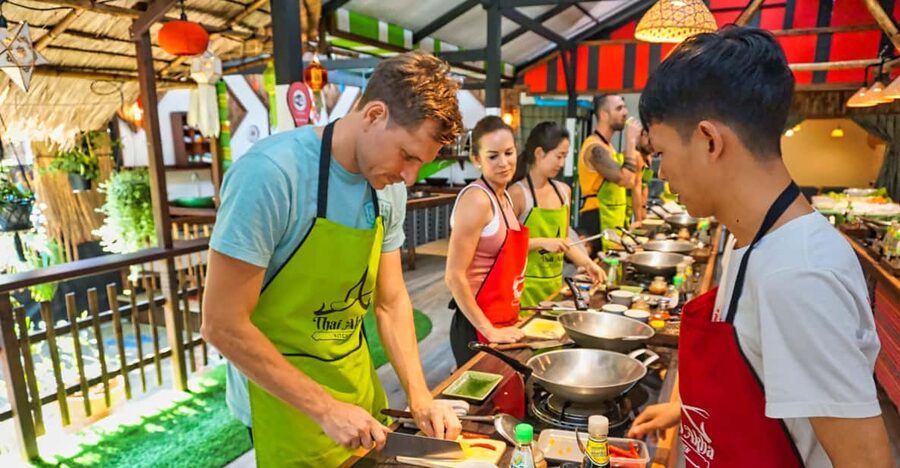
Chiang Mai’s Thai Akha Kitchen class begins where good cooking begins: at the market. You’ll see the produce, herbs, spices, and local treats before returning to cook a generous menu of Thai and Akha food. The Akha influence gives the class a useful cultural angle, not just another lesson in green curry.
I like the market-to-table format, which helps you understand why fresh ingredients matter in northern Thai cooking. I also like the sheer amount of food: two appetizers, two desserts, three Akha dishes, and four more dishes chosen from curry, soup, stir-fry, and pad Thai options. The main consideration is time. At five to six hours, this is a substantial half-day activity, not a quick tourist cooking demo.
In This Review
- Key points to know before booking
- Why the market tour matters in Chiang Mai
- From Akha tradition to the cooking table
- Cooking 11 dishes without losing the plot
- Choosing your curry, soup, and stir-fry
- What the teaching style feels like
- Hotel pickup and the five to six hour schedule
- Is $41 good value?
- Food allergies and practical preparation
- Who will enjoy this class most
- Should you book the Thai Akha cooking class?
- FAQ
- Where does the cooking class take place?
- How long does the experience last?
- Is hotel pickup included?
- What languages are spoken by the instructors?
- How much does the experience cost?
- What Akha dishes will I cook?
- Can I choose which curry I cook?
- Can I choose which soup I cook?
- Are recipes and cooking materials included?
- What should I do if I have a food allergy?
- Can I cancel for a full refund?
- Can I reserve without paying immediately?
Key points to know before booking

- The morning market sets up the whole lesson: You see and select ingredients before cooking them.
- The menu can reach 11 dishes: You prepare two appetizers, three Akha dishes, two desserts, and four selected main dishes.
- Akha food adds a northern Thai angle: Expect tomato dipping sauce, a fresh Akha salad, and Akha soup alongside familiar Thai favorites.
- You choose several main dishes: Pick one curry, one Thai soup, one stir-fried dish, and Pad Thai is one of the stir-fry choices.
- Hotel pickup is included: Pickup is available from hotels in Chiang Mai.
- You leave with practical material: A recipe book, cookbook, and spices are included, along with the cooking session and organic ingredients.
Why the market tour matters in Chiang Mai
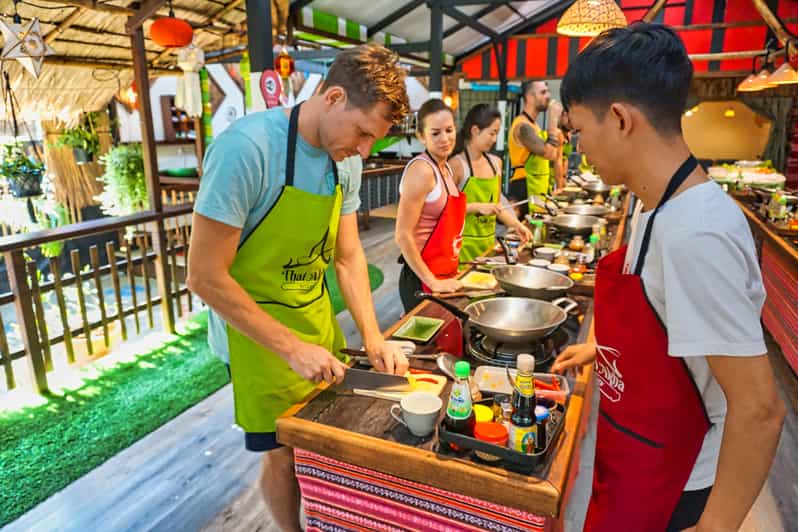
The first useful lesson here is not a recipe. It is shopping.
The local market tour gives you a look at the raw materials behind Thai cooking, from vegetables and herbs to curry ingredients and snacks. You can expect to learn about the ingredients used in the class and sample local delicacies and treats. That small tasting element helps you connect the market to the meal you will cook later.
I like this beginning because Thai recipes often look simple on paper. A salad may have only a handful of ingredients, but the freshness of the lime, herbs, tomatoes, cucumber, and peppers affects the final dish. Seeing the ingredients before they are chopped gives you a better sense of what to seek out when you cook at home.
The tour is also useful for anyone who finds Thai markets confusing. You do not have to guess which herbs matter or how local produce fits into a meal. The cooking team can explain the ingredients as part of the class, with instruction available in English and Thai.
One practical point: market visits mean walking and standing before the cooking begins. Wear comfortable shoes and clothing that can handle a warm kitchen. The available information does not specify the market name, group size, or exact walking distance, so ask the provider if those details affect your plans.
More Thai Cooking Classes in Chiang Mai
- Half-Day Thai Cooking Class at Organic Farm in Chiang Mai
★ 5.0 · 19,087 reviews - Chiang Mai: Cooking Class, Market & Thai Herbs Garden Tour
★ 4.9 · 4,824 reviews - Chiang Mai: Authentic Cooking Class with Market & Farm Visit
★ 4.9 · 4,546 reviews
From Akha tradition to the cooking table
The class centers on the food traditions of the Akha people, an ethnic group whose descendants migrated to Thailand in the early 1900s. The cooking school presents Akha food as fresh, health-minded, and connected to the mountain communities where these habits developed.
You will not spend the entire session cooking only Akha dishes. Instead, the class combines Akha recipes with well-known Thai food. That blend works well for first-time cooks because you get both something distinctive and something familiar.
The three listed Akha dishes are:
- Sapi Thong, a tomato dipping sauce
- Akha salad, made with tomato, cucumber, coriander, pepper, lime juice, salt, and ground peanuts
- Akha soup
The Akha salad is especially easy to understand as a lesson. Its ingredients are straightforward, but the balance of sour lime, fresh vegetables, seasoning, and ground peanuts shows how a few good components can make a complete dish. Sapi Thong also gives you a different way to use tomatoes, rather than treating them only as a salad ingredient.
The cultural content is present through the food and the cooking story. If you want a long, formal lecture on Akha history, this may feel light. If you prefer learning about culture through ingredients, recipes, and the cooks who prepare them, the format should suit you better.
Cooking 11 dishes without losing the plot
The menu looks large, but the structure makes it easier to follow.
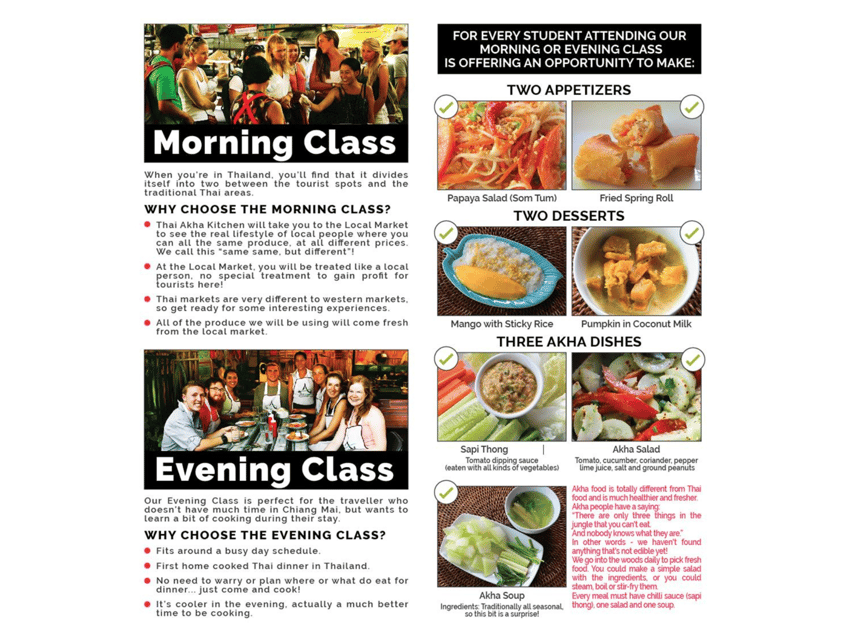
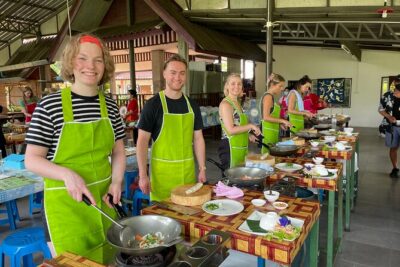
You prepare two appetizers: papaya salad and fried spring rolls. These teach two very different techniques. Papaya salad focuses on balancing sharp, salty, fresh, and spicy flavors. Spring rolls bring in filling, wrapping, and frying.
You also make two desserts: mango with sticky rice and pumpkin in coconut milk. The mango and sticky rice is a familiar Thai favorite, while pumpkin in coconut milk offers a less common sweet finish. Having dessert built into the class is a good idea, since it shows that Thai cooking is not only about chilies, herbs, and savory sauces.
The three Akha dishes follow, or are worked into, the main cooking session. The exact order can vary, but the class is designed as a hands-on lesson rather than a demonstration where you simply watch a chef work.
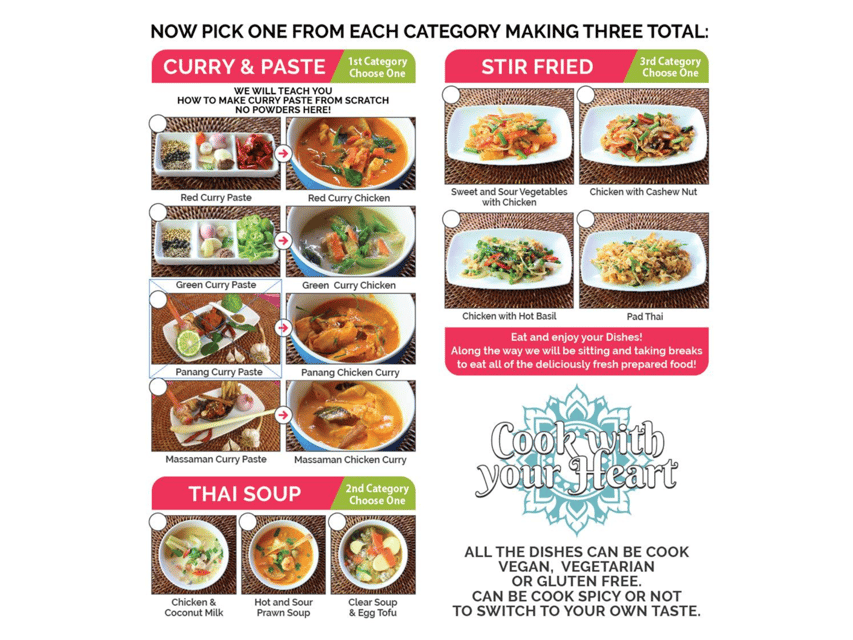
Then you choose one dish from each of four groups:
Curry, choose one:
- Red curry chicken
- Green curry chicken
- Panang chicken curry
- Massaman chicken curry
Thai soup, choose one:
- Chicken with coconut milk
- Hot and sour prawn soup
- Clear soup with egg tofu
Stir-fried dish, choose one:
- Sweet and sour vegetables and chicken
- Chicken with hot basil
- Chicken with cashew nut
- Pad Thai
That means the full menu totals 11 dishes: two appetizers, two desserts, three Akha dishes, one curry, one soup, and one stir-fried dish. The precise serving arrangement is not stated, but you should expect a lot of eating as well as cooking.
The menu choices are helpful for mixed groups. One person can choose Pad Thai while another picks chicken with hot basil. Someone who prefers seafood can select the prawn soup, while another can stay with chicken or tofu. You can also adjust the level of heat to your taste, an important detail if you enjoy Thai food but do not yet have a high tolerance for chilies.
Choosing your curry, soup, and stir-fry
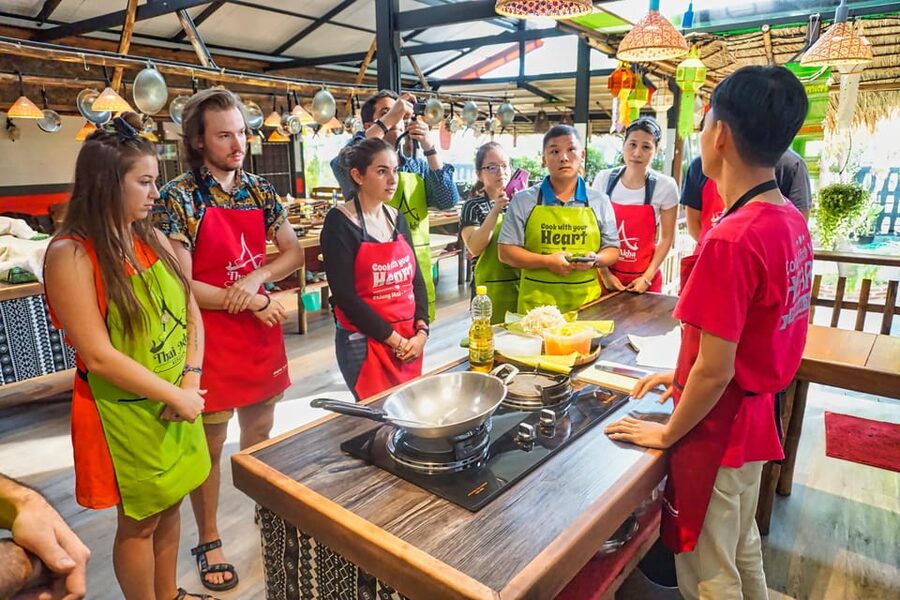
Your choices shape the character of the class.
Green curry is often the most herb-led option on this menu, while red curry gives you a broader chili profile. Panang curry is another good choice if you prefer a thicker, richer curry style, and Massaman offers a milder direction with a different spice profile. The provided menu identifies chicken for all four curries, so this is not a seafood or vegetarian curry class.
The soup options cover three distinct moods. Chicken with coconut milk gives you a creamy, fragrant soup. Hot and sour prawn soup brings sharper flavors and seafood. Clear soup with egg tofu is the mildest-sounding choice and may suit you if you want less heat or a gentler dish.
For the stir-fry, Pad Thai is the obvious comfort pick. Chicken with hot basil gives you a spicier, more aromatic plate, while chicken with cashew nut and sweet and sour vegetables with chicken offer other familiar combinations.
The class does not promise a fully vegetarian menu, and the listed main choices include chicken, prawns, or egg tofu. If you have dietary restrictions, contact the provider before the class rather than relying on changes at the last minute.
Same coastline, a completely different day out:
- Chiang Mai: Elephant Sanctuary, Waterfall & Bamboo Rafting
★ 4.9 · 9,160 reviews - Chiang Mai: Doi Inthanon National Park Eco-Friendly Tour
★ 4.6 · 6,667 reviews - Chiang Mai: Elephant Sanctuary & Waterfall Group Tour
★ 4.9 · 5,780 reviews - Chiang Mai: Chiang Rai Temples, Karen Tribe and Hot Springs
★ 4.7 · 5,401 reviews
What the teaching style feels like
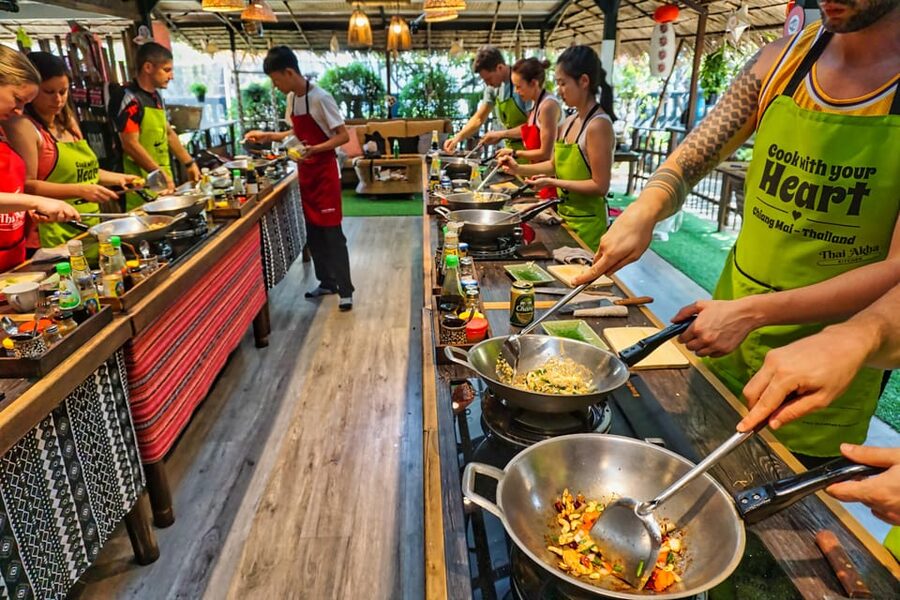
The cooks guide you step by step through the ingredients and preparation. English and Thai are the listed teaching languages. Named cooks associated with the class include An, Xuan, and Evelyn, though the exact instructor may depend on the date and session.
An has been singled out as the teacher for one class, while Xuan and Evelyn have also led sessions. The important practical detail is that this is a personal cooking lesson, not a generic video presentation. You work at the table and in the kitchen, with the chance to adapt spice levels to your own taste.
The pace appears designed to keep the group moving through many dishes. That is a strength, since you get broad coverage in one session. It also means you should not expect to master every technique in perfect detail. The class introduces a wide range of recipes, rather than spending an entire afternoon on one curry paste.
You can expect the staff to help with preparation and cooking, but the supplied information does not give a fixed group size or a precise student-to-instructor ratio. If close individual instruction is your main goal, ask about the class size before booking.
Hotel pickup and the five to six hour schedule
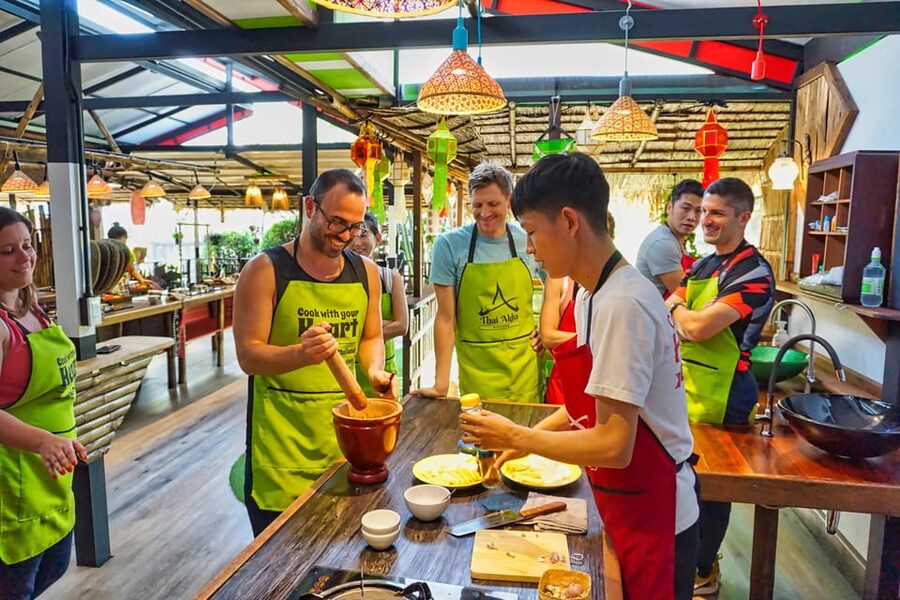
Pickup from a Chiang Mai hotel is included, which makes the day easier. Chiang Mai traffic and unfamiliar roads can turn a simple market visit into a planning chore, so having transport arranged is useful.
The total duration is five to six hours. A market visit comes first, followed by the cooking session, which can take about three hours according to the available class description. The exact start time depends on availability, so check the date you want.
This schedule is best treated as a major morning or afternoon commitment. Do not place it beside another fixed tour with a tight departure time. The class includes market time, ingredient selection, cooking, eating, and instruction, so the length makes sense, but it is not designed for people rushing between attractions.
The morning version includes the market experience in a natural way, and an evening class is also offered. The information confirms that both morning and evening sessions exist, but it does not provide separate menus or detailed schedules for each.
Is $41 good value?
At $41 per person, this class offers solid value if you want more than a single meal.
The price includes hotel pickup from a Chiang Mai hotel, the market tour, cooking instruction, organic ingredients, the recipes, and a cookbook. It also includes a large meal, though the exact portion size and whether every dish is served for individual tasting are not specified.
The recipe material matters. A cooking class has limited value if the food disappears and the method disappears with it. Here, you receive recipes and a cookbook, and spices have also been provided as part of the experience. That gives you a better chance of recreating at least some of the dishes after returning home.
The price is less attractive if you dislike group cooking, do not want to spend five to six hours on food, or would rather eat at a restaurant. It is also not the right choice if your main interest is a specialized vegetarian or vegan lesson, since the listed menu centers on chicken and includes prawns in one soup option.
For a half-day activity that combines transport, a market visit, instruction, ingredients, and a full menu, I consider $41 reasonable. You are paying for participation and context, not just lunch.
Food allergies and practical preparation
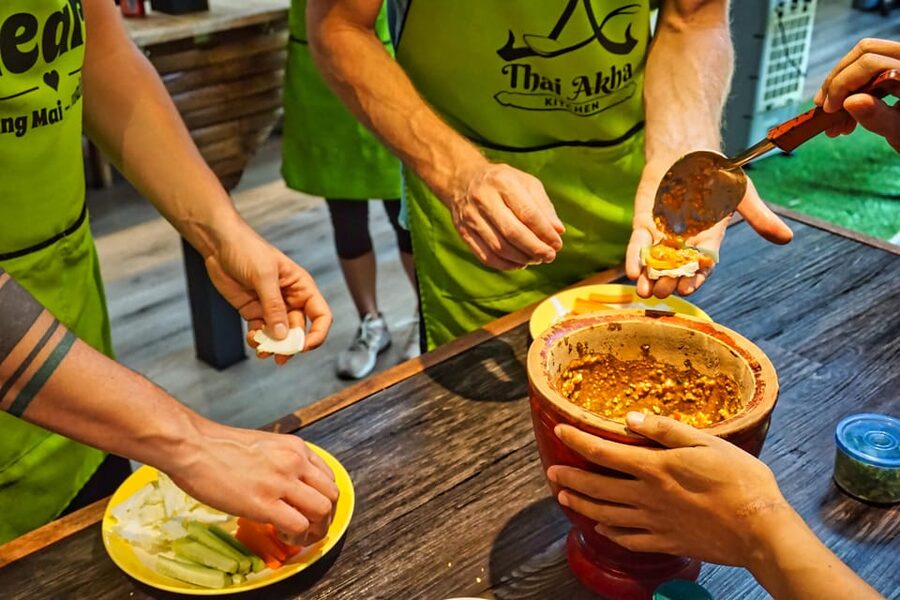
Tell the provider about food allergies in advance by email or WhatsApp. This is especially important here because the menu includes peanuts, coconut milk, chicken, prawns, egg tofu, and several spice-heavy dishes.
The Akha salad contains ground peanuts, and the menu includes seafood in the hot and sour prawn soup. The class also offers multiple curries and stir-fries, so the cooking team may be able to explain possible choices, but you should make your needs clear before arrival.
Personal expenses are not included. The included items cover the class itself, market session, ingredients, recipes, cookbook, and hotel pickup. Bring money only for anything additional you choose to buy, since no personal spending allowance is part of the activity.
The free cancellation policy allows a full refund when you cancel at least 24 hours in advance. You can also reserve now and pay later, which helps if your Chiang Mai schedule is still changing.
Who will enjoy this class most

I would recommend it to you if you like to understand a place through food rather than simply eat it. The market gives you context, the Akha recipes add a northern Thai connection, and the Thai menu provides dishes you may already recognize.
It is also a good fit for couples, families, and small groups with different spice preferences. The menu has enough choices to prevent everyone from cooking the exact same meal, and the cooking team can adjust heat to individual tastes.
You should think twice if you want a quiet, short activity. The class is busy in the literal sense of having many dishes to prepare, and the five to six hour length requires energy. It may also disappoint you if you expect an advanced chef course. This is a friendly, practical introduction with a wide menu, not a professional certification lesson.
Should you book the Thai Akha cooking class?
Book it if you want a hands-on Chiang Mai experience that combines local market shopping, Akha food, and classic Thai recipes in one day. The unusually broad menu, included transport, recipe materials, and $41 price make it a strong pick for food-focused visitors.
Skip it if you have severe dietary limits that cannot be discussed in advance, dislike long cooking sessions, or want a highly specialized class. Otherwise, this is the kind of activity that can stay useful after your holiday: you eat well in Chiang Mai, learn why the ingredients matter, and take home recipes you can try in your own kitchen.
FAQ
Where does the cooking class take place?
The cooking class takes place at Thai Akha Kitchen in Chiang Mai Province, Thailand.
How long does the experience last?
The activity lasts five to six hours. The cooking session itself may take about three hours, with the market tour and other parts of the experience included in the total.
Is hotel pickup included?
Yes. Pickup service from a Chiang Mai hotel is included.
What languages are spoken by the instructors?
Instruction is available in English and Thai.
How much does the experience cost?
The listed price is $41 per person.
What Akha dishes will I cook?
The Akha dishes listed are Sapi Thong tomato dipping sauce, Akha salad with tomato, cucumber, coriander, pepper, lime juice, salt, and ground peanuts, and Akha soup.
Can I choose which curry I cook?
Yes. You choose one curry from red curry chicken, green curry chicken, Panang chicken curry, and Massaman chicken curry.
Can I choose which soup I cook?
Yes. The soup choices are chicken with coconut milk, hot and sour prawn soup, and clear soup with egg tofu.
Are recipes and cooking materials included?
Yes. Organic ingredients, recipes, and a cookbook are included. Spices may also be provided as part of the cooking experience.
What should I do if I have a food allergy?
Tell the provider about your allergy in advance by email or WhatsApp. The menu includes peanuts, prawns, chicken, egg tofu, coconut milk, and spicy ingredients.
Can I cancel for a full refund?
Yes. You can cancel up to 24 hours in advance for a full refund.
Can I reserve without paying immediately?
Yes. The reserve-now, pay-later option lets you book your place without paying at the time of reservation.
More Shopping Tours in Chiang Mai
- Evening Cooking Class in Organic Farm with Local Market Tour
★ 5.0 · 394 reviews - Chiang Mai: Elephants, Sticky Waterfalls, Market and Temple
★ 4.9 · 227 reviews - Half-Day Cooking Class with Market Tour
★ 5.0 · 163 reviews - Chiang Mai: Traditional Thai Cooking Class with Market Tour
★ 4.8 · 137 reviews
More Markets in Chiang Mai
- Chiang Mai: Cooking Class with Market and Pickup
★ 4.9 · 1,365 reviews - Chiang Mai: Evening Cooking Class and Local Market Visit
★ 4.9 · 648 reviews - Chiang Mai: Evening Local Street Food Market Tour
★ 4.8 · 604 reviews - Chiang Mai: Kalare Night Bazaar Boxing Stadium Muay Thai
★ 4.7 · 507 reviews
Just added around Chiang Mai
- Taste of Chiang Mai: Michelin Guide & Street Food Tour★ 4.9 · 159 reviews
- Red, Blue, White Temples & Hot Spring Trip from Chiang Mai★ 4.4 · 143 reviews
- From Chiang Mai: Mae Taeng Valley and Waterfalls Cycle Tour★ 4.9 · 159 reviews
- Long Neck Village, Silver Temple & Chiang Mai Top Sites★ 4.7 · 17 reviews
- Chiang Mai: Local Northern Thai Cooking Class at Grandma’s★ 5.0 · 33 reviews
- Chiang Mai: Khum Khantoke Northern Thai Cuisine and Show★ 4.3 · 38 reviews
- Private : Sticky Waterfall & Secret Temple & Karen Village.★ 5.0 · 9 reviews
- Half-day with CHIANGMAI ELEPHANT CARE program (12pm-6pm.)★ 5.0 · 27 reviews
Thai Cooking Classes, compared.
Half-Day Thai Cooking Class at Organic Farm in Chiang Mai
Read our review →
Cooking Class, Market & Thai Herbs Garden Tour
Read our review →
Authentic Cooking Class with Market & Farm Visit
Read our review →
Phuket Thai Cooking Class with Market Tour Option
Read our review →
Tingly Thai Cooking School Half-Day Cooking Class
Read our review →Browse the lists this tour appears in